4 Days in Car-Free Zermatt

Zermatt doesn’t have cars. That’s the first thing you need to know — and it changes everything about how the village feels: quieter, slower, organized entirely around the mountain it exists to look at.
(Quick note: this post contains affiliate links. Book through them and we earn a small commission at no extra cost to you. We only recommend what we use.)
Zermatt is the rare famous place that’s better than its reputation. One impossibly photogenic mountain, a level of Swiss precision that makes the whole trip feel effortless — once you’ve made three or four smart decisions in advance. Here they are.
Decision One: How You Arrive
Zermatt is car-free, full stop. You arrive by train (the final leg from Täsch or the full Glacier Express experience) or you book a transfer to Täsch and ride the shuttle train the last five minutes.
From Geneva or Zurich airports, the rail journey is half the fun — but if you’re traveling as a group or with ski gear, a private door-to-Täsch transfer often beats four train tickets on both price and sanity. For longer intercity transfers like this we use GetTransfer, which lets drivers bid on your route — surprisingly effective for exactly this kind of airport-to-alps run.
Price your airport transfer here
And before you land in Switzerland at all: set up your eSIM. Swiss roaming charges are notoriously brutal for non-EU plans. We install Airalo before every European trip — activated on landing, a fraction of carrier roaming costs.
Get your Switzerland eSIM here
Decision Two: Where You Sleep
Zermatt does two kinds of stays brilliantly, and we recommend one of each depending on your trip.
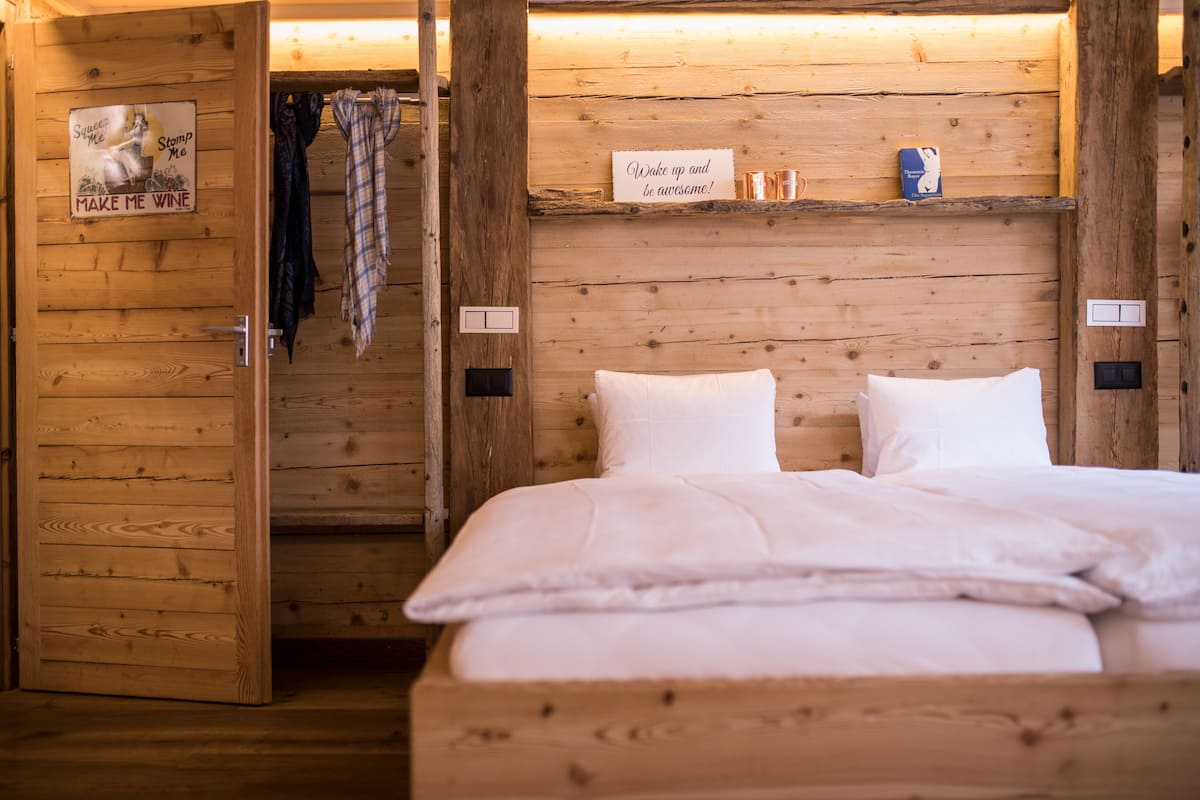
For the hotel experience: the Backstage Hotel — a design-forward boutique property steps from the Matterhorn lift stations, with a spa and one of the most distinctive interiors in the Alps (the same family built the village’s beloved Vernissage cinema-bar, and it shows). For a 3–4 night trip where you want everything handled, this is the one.
Book the Backstage direct here
For settling in: a proper alpine flat. Our pick is a cozy apartment in the heart of the village — wake up to mountain views, walk to the lifts, shop the morning bakery like you live there. For stays of four nights or more, or any trip where you’d rather have a kitchen and a living room than a minibar, the flat wins.
See the Zermatt Alpine Flat here
Day One: Arrive, Walk, Look Up
The train pulls in, you walk (or take an electric taxi) to your stay, and then the village does the rest. Walk the Bahnhofstrasse, cross to the Hinterdorf quarter — 16th-century larch-wood barns on stone stilts, the oldest corner of Zermatt — and find your first proper viewpoint of the Matterhorn at the Kirchbrücke bridge at dusk. Dinner: fondue at a traditional stübli. Yes, it’s the cliché. It’s also correct.
Day Two: Gornergrat — the Essential Day
The Gornergrat Bahn, Europe’s first fully electrified cog railway, climbs to 3,089 meters with the Matterhorn filling the left-side windows the entire way (sit on the right going up for the Gorner Glacier — you’ll see the Matterhorn plenty). At the top: a 360-degree panorama over twenty-nine 4,000-meter peaks.
The move locals know: ride up early, then walk back down one or two stations along the Riffelseeweg — the little lake at Riffelsee throws a perfect Matterhorn reflection on still mornings.
Day Three: Glacier Paradise and the Long Lunch
Matterhorn Glacier Paradise is the highest cable car station in Europe at 3,883 meters — an ice palace carved into the glacier, and on clear days a view that stretches to Mont Blanc. Go early for the clearest air; bring real layers even in August.
Afternoon: ride partway down and get off at Furi for lunch on a sun terrace, or hike the larch forests back toward the village. In winter this entire day is replaced by skiing the largest summer-free ski area in the Alps — Zermatt’s pistes connect over the Italian border into Cervinia, and you can lunch in Italy and ski home.
Day-of-trip tickets and mountain experiences (paragliding over the village, guided glacier hikes, photography tours at sunrise) are worth booking ahead in peak season — we use Tripadvisor to compare the guided options here.
Browse Zermatt experiences here
Day Four: The Slow Goodbye
Sunrise from your balcony, one last bakery run, and if your legs have anything left, the Five Lakes Walk (Stellisee to Leisee) is the most concentrated dose of Matterhorn-reflection scenery in the valley. Afternoon train out — or transfer from Täsch if that’s how you came.
The Honest Budget Talk
Zermatt is expensive. It is also one of the few places on earth where the expensive version and the smart version are the same trip with different booking decisions. The flat with a kitchen cuts food costs in half. Booking the Backstage direct gets you the best available rate and their own perks rather than a platform’s cut. The eSIM saves a phone bill horror story. And shoulder seasons — late June, September — deliver the same mountain at noticeably softer prices.
Every platform we use for trips like this lives on our Plan Your Trip page.
And both Zermatt stays, plus every other property we recommend, are on Stay Here.
No cars, no noise, one mountain you’ll never stop photographing. Four days is the minimum. You’ll know that by day two.